ADPList

2024

Turning mentor search into an AI conversation

Turning mentor search into an AI conversation

I turned mentor search into an AI conversation that maps what a mentee needs to a mentor who will actually show up. Activation rose 48%. 68% of mentees who had the conversation booked a session.

I turned mentor search into an AI conversation that maps what a mentee needs to a mentor who will actually show up. Activation rose 48%. 68% of mentees who had the conversation booked a session.

Role

Design lead. Owned strategy, design, PM and rollout.

Timeline

6 weeks • Apr 2024

Live • Shipped

Role

Design lead. Owned strategy, design, PM and rollout.

Timeline

6 weeks • Apr 2024

Live • Shipped

Overview

Search became a conversation

Search became a conversation

Mentees knew they needed help. They couldn't turn a messy career situation into a search query. So I removed the query. Mentees describe their situation in plain words, the AI pulls candidates, and ADPList's own signals decide the ranking. Activation rose 48%. 68% of mentees who had the conversation booked a session.

The team's read was that search had a data and filter problem. I argued it was an intent problem, and that every retention project was wasted until we fixed it. You can't retain someone you never activated.

Problem

Onboarding worked. Booking didn't.

74% of new mentees finished onboarding. Then they took more than 24 hours to book a first session. That time went into shortlisting mentors who couldn't take the call.

Available didn't mean active. Mentors showed up in results and never responded. Mentees booked, got no-shows and stopped trusting ADPList.

Demand piled onto logos. Mentees searched Google, Apple, Meta. Those mentors sat behind 100+ person waitlists. Equally qualified mentors got few bookings and no idea why.

More filters didn't help. The platform kept adding filter depth. None of it helped a mentee who couldn't name what they needed.

Approach

Let mentees say what they need

Lead with intent

Mentees describe their situation in their own words. The AI reads goals, availability and fit, then returns matches.

Make the first message easy

The riskiest moment in a chat is the empty box. Pre-written starters took the effort of the first message close to zero.

Compare without leaving the chat

Opening full profiles to compare broke the flow right before the booking decision. Quick view lets mentees judge a match and stay in the conversation.

Match both sides

The AI matched what a mentee wanted with what a mentor said they were there to give. Better input on both sides, better matches.

Decisions

Three calls that shaped the launch
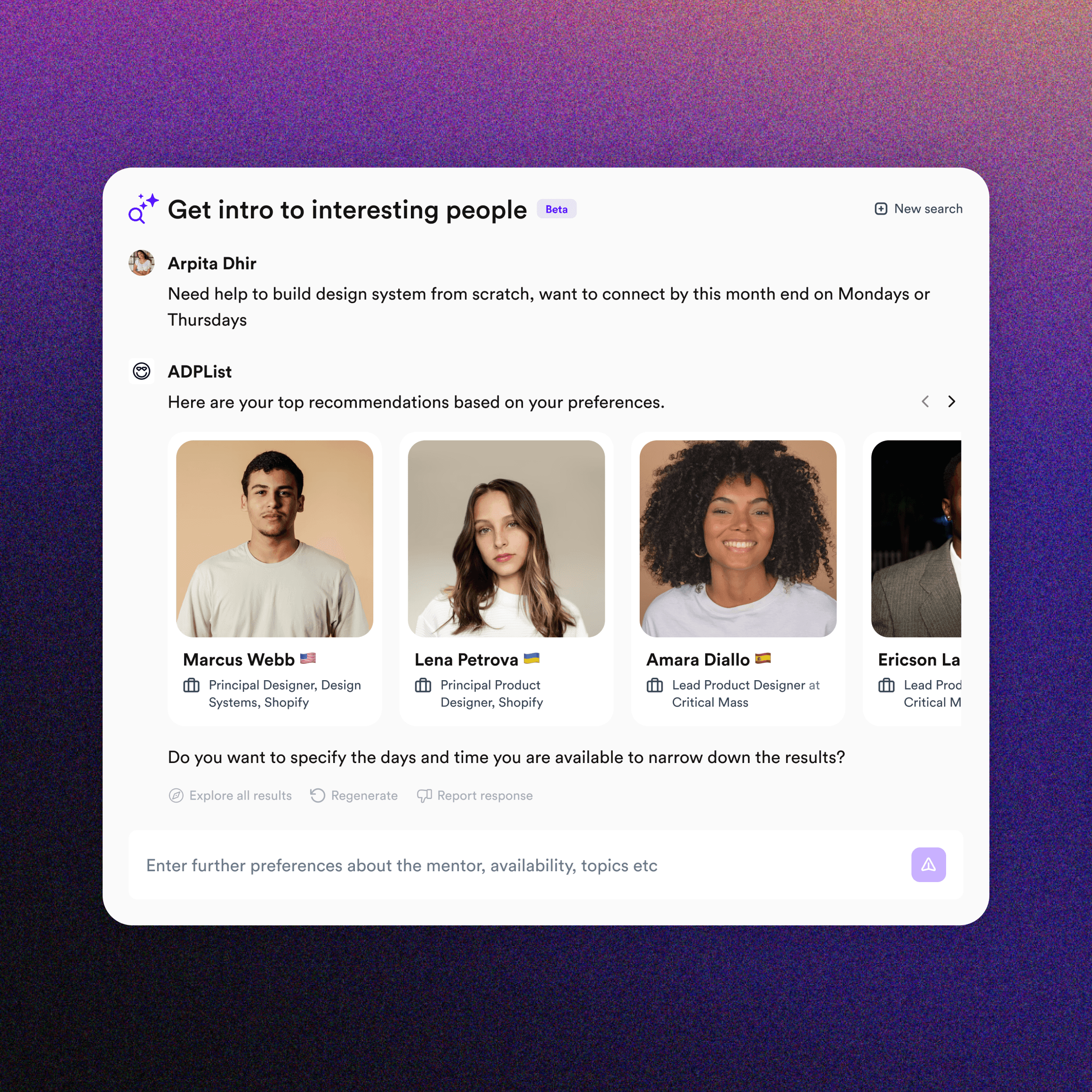
Engineering wanted more context. I shipped results on the first message.

Engineering's position: the AI needed several exchanges before recommending anyone. I pushed back. Every turn before a result is a turn where mentees drop. We showed candidates after the first prompt and used later turns to refine. The tradeoff: the first list works with less context, so refinement has to do more of the work.

The AI suggests. ADPList ranks.

AI-owned ranking would have been a black box. No way to explain why one mentor beat another. No way to tell if results were better than filters or just different. So the AI pulls candidates and platform signals rank them. That call also dealt with mentors who looked available but weren't reachable.

Engineering pushed back on tracking. I held the line.

I wanted every query, turn, prompt selection and drop-off logged. Engineering saw extra effort for a v1. Without that data, we couldn't iterate fast. The first post-launch fix came straight out of it.

Iteration

What launch data changed

Prompts were a click away. We moved them up front.

Mentees weren't writing strong first prompts because the suggestions were hidden. We put them on the first screen, so intent was easy to express from the start.

Prompts were a click away. We moved them up front.

Mentees weren't writing strong first prompts because the suggestions were hidden. We put them on the first screen, so intent was easy to express from the start.

Impact

Mentees stopped searching and started booking

For ADPList

Activation rose 48% and sessions grew 56%. Fixing discovery moved the number every retention project had been waiting on.

For ADPList

Activation rose 48% and sessions grew 56%. Fixing discovery moved the number every retention project had been waiting on.

For mentees

92% of new mentees chose the conversation over search. 68% of them booked a session, and the wait for a first booking dropped by 22 hours.

For mentees

92% of new mentees chose the conversation over search. 68% of them booked a session, and the wait for a first booking dropped by 22 hours.

Reflections

What worked

  • Effort was the problem, not result quality. Finding a reliable match took so much work that mentees wrote off the outcome before they met anyone.

  • AI made the two-sided problem visible. Sometimes the bottleneck was how mentees described their need. Sometimes mentor data. Sometimes activity signals. Now we could see which.