ADPList

2025

Turning mentor recognition into a growth loop

Turning mentor recognition into a growth loop

As sole designer and acting PM, I replaced a manual monthly certificate process with a recognition system 32,000 mentors could earn and share. Recognition alone drove 20% month-on-month booking growth.

As sole designer and acting PM, I replaced a manual monthly certificate process with a recognition system 32,000 mentors could earn and share. Recognition alone drove 20% month-on-month booking growth.

Role

Sole designer and acting PM. Owned the problem, tier logic, scope and rollout.

Timeline

4 weeks • Jan 2025

Live • Shipped

Role

Sole designer and acting PM. Owned the problem, tier logic, scope and rollout.

Timeline

4 weeks • Jan 2025

Live • Shipped

Overview

Recognition became an acquisition loop

Recognition became an acquisition loop

Recognition at ADPList was two people, a spreadsheet and an inbox. Nobody outside the inbox ever saw it. I turned it into a system that runs itself and gives mentors something worth posting. 95% of recognised mentors shared their certificate outside ADPList, and recognition alone drove 20% month-on-month booking growth.

It started with 3 months of mentor interviews I ran for the roadmap. I pitched recognition for Q1 because one build hit three OKRs: mentor retention, ops load and organic growth. Engineering said no at first. It still shipped in 4 weeks.

Problem

Recognition existed. Nobody could see it.

Recognition couldn't travel. A certificate in an inbox reaches one person. Mentors had real achievements and no way to show them to their network, so ADPList's best advocates had nothing to post.

A number isn't recognition. Profiles showed session counts with no context. They told mentees how busy a mentor was, not how good.

New mentors had nothing to aim for. Unless you were already in the global top 1%, the system ignored you. Mentors who feel unseen leave before they hit their stride.

Two people held the whole thing up. One resignation and recognition stopped. And a hand-made image can never live on a profile page.

Five manual steps, every month, run by two people. The certificate ended in an inbox, so no mentee ever saw it.

Research

Mentors wanted to see their progress, and wanted mentees to see it too

Over 3 months, I ran 300+ mentor interviews myself to plan what came next on the roadmap. One question kept pulling focus: what keeps a mentor showing up month after month? The same three answers came back. Track my own impact. Earn something real. Let my mentees see it.

283 mentors asked to see their certificate on their profile. That became the brief.

That maps to Self-Determination Theory: people keep going when they feel capable and seen. It shaped two choices. Show mentors their progress before the milestone, and put recognition where mentees make booking decisions.

The booking flow was built for one call. Nothing on these screens let a mentee commit to a mentor over time.

Approach

One ladder for every stage of a mentor's journey
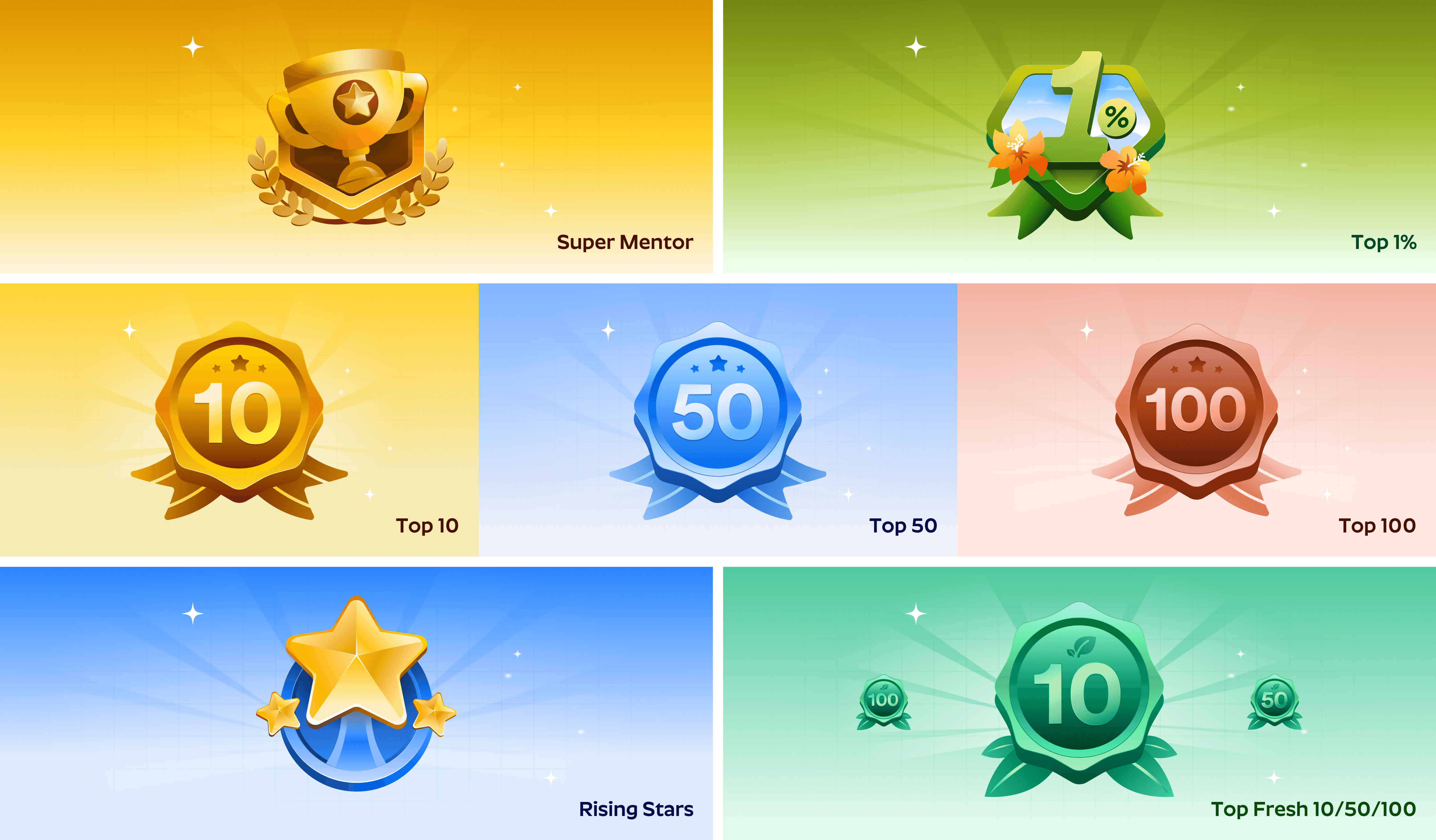
― Four tiers, each for a different kind of mentor

One leaderboard would only ever reward the same 1%. Each tier rewards a different shape of contribution.

  • Top 1%: peak performance. 12+ completed sessions in 30 days, ranked globally. Monthly.

  • Rising Star: early momentum. For mentors approved in the last 30 days: 12+ completed sessions. Monthly.

  • Super Mentor: sustained quality. 36+ sessions in 90 days, 100+ lifetime, 90% attendance, 4.8+ rating. Quarterly.

  • Top 10/50/100: expertise. Ranked by lifetime sessions per discipline, plus separate rankings for women mentors and mentors in their first 90 days. Quarterly.

9 badges for four kinds of mentor recognition.

― Progress shows up before the milestone

A progress bar on the dashboard, and an email when a mentor is 2 sessions away. The email moved more than the bar.

After every session, mentors see how close they are to the next badge.

― The modal marks the moment. The email keeps it.

Badge earned: a celebration modal fires on the platform and an email goes out at the same time.

The modal fires once in product. The email lands in the inbox, where the mentor can find it and share it later.

― Certificates built to be posted

HTML-generated, so nobody makes them by hand. 12 unique Top 1% designs, one per month, sized for LinkedIn, Slack and portfolios. 95% of recognised mentors shared theirs. Every share was a free ad for ADPList.

95% of recognised mentors shared theirs. Those shares lifted bookings 20%.

― Badges moved onto the profile

Recognition finally showed up where mentees decide who to book. The gap: we couldn't backfill certificates mentors earned before launch.

An Achievements tab on every profile, with session milestones and community badges, where mentees decide who to book.

Decisions

Four calls that shaped the system

― Engineering said no. I made it an ops risk.

Engineering passed in the first meeting. Their roadmap was full and the community team looked like it was coping. So I stopped pitching a design request. Two people can't email 300+ mentors a month forever, and a hand-made image can never sit on a profile. I brought a cost-benefit and fallback logic the same week. Engineering was in.

Month end and quarter end trigger the rules, every tier is assigned automatically, and five outputs go out with zero manual steps.

― Super Mentor stayed hard.

The community team pushed to lower the bar, since most mentors would never reach it. I kept it high, because a badge everyone has tells a mentee nothing. The cost: only 240+ of 32,000 mentors made it. Rising Star and the discipline rankings gave everyone else a real lane, not a consolation prize. A booking that never happens earns nothing.

Four filters take 32,000 mentors down to 240+ Super Mentors.

― The illustrator wanted one certificate. We shipped 13, because sharing was the growth loop.

I'd scoped 20 unique designs. The illustrator pushed back: start with one generic design and iterate later. But Top 1% is earned monthly, and the same certificate posted every month stops getting shared. Sharing was the acquisition loop. So we split it: 12 unique designs for Top 1%, and one shared design with a different badge for every other tier, since those are harder to earn or earned once.

Top 1% gets a new design every month, so a mentor who earns it again has a new reason to post. Every other tier shares one template with its own badge.

― I moved ranking from what mentors said to what they did.

After launch, mentors flagged that they weren't one thing. A UX designer might also mentor on product and leadership, but their ranking only showed the first field they picked at signup. I changed the logic so session topics and mentee requests decide where a mentor ranks. The trade: mentors lost control of their own category. Expertise now comes from behaviour, not a dropdown.

Session topics and mentee requests decide where a mentor ranks.

Impact

Recognition alone drove 20% month-on-month booking growth

― For mentors

90-day mentor retention rose 33%.

95% of recognised mentors shared their certificate outside ADPList. They finally got recognition where they asked for it: on their profile, where mentees book, and in front of their own network.

Super Mentors fed directly into ADPList Advance, our paid mentorship programme.

― For the business

Bookings are ADPList's north star. When mentors get booked, they stay, and every booking adds activity on both sides of the platform.

Recognition alone drove 20% month-on-month booking growth, half of a 40% goal shared across several features.

The monthly manual process 100% gone. Organic user acquisition grew 30%.

Reflections

What worked

  • Recognition is distribution. I designed certificates for mentors. Their networks became a booking channel we didn't pay for.

  • Nudges beat dashboards. The email two sessions out did more than a progress bar mentors had to go and find.

What I'd do differently

  • Plan for history on day one. We launched without past certificates, so mentors who earned recognition before launch lost it on their profile.

  • Rank by behaviour from the start. We trusted the one discipline mentors picked at signup. Session data already knew better.