ADPList

2025

Making session context available & usable

Making session context available & usable

I led and designed Journals: AI-generated mentorship notes. It was critical to maintain trust + get the timing right, as mentorship sessions are private and notes had to reach users in time to be useful.

I led and designed Journals: AI-generated mentorship notes. It was critical to maintain trust + get the timing right, as mentorship sessions are private and notes had to reach users in time to be useful.

Role

Design lead – Owned discovery, strategy, research, design, metrics and rollout

Timeline

6 weeks • July 2025

Live • Shipped

Role

Design lead – Owned discovery, strategy, research, design, metrics and rollout

Timeline

6 weeks • July 2025

Live • Shipped

Overview

AI Notes turned one-off sessions into repeat mentorships

AI Notes turned one-off sessions into repeat mentorships

Growth depended only on new signups, the business wanted to change that. ADPList had 300K+ members and 35K+ mentors, but most mentees switched mentors instead of returning to one. Mentors only stayed busy while new mentees kept arriving. The goal was more second sessions with the same mentor, because mentors stay when their sessions lead somewhere.

The work focused on capturing session context automatically and making it easy to return to.

The result: 63% of returning mentees rebooked the same mentor. Mentee retention 22% and mentor retention rose 34% over 90 days. One-off sessions started turning into relationships.

Problem

Every Session Ended & Progress Went With It

On ADPList, when a call ended, the tab closed and everything said in it was gone. So most mentees treated each call as a one-off. 7 in 10 bookings were first meetings.

Mentees needed mentorship that got them to their goals

That meant carrying the full context from call to call: their goals, what they tried and what came next.

Mentors needed to see their advice go somewhere

That meant following each mentee's progress from one call to the next.

The platform gave them neither. Notes were manual and hidden, and nobody rewatched the recordings.

Connections - The feature was launched in 2021 but was high effort and hidden.

Research

Data found who. Interviews found why.

Retention followed continuity. I went into Amplitude to find what kept people on the platform. Two behaviours stood out: mentees who kept meeting the same mentors retained 39% better, and users who exchanged notes retained 25% better than those who didn't.

To understand why, I interviewed three categories

  • mentees who kept returning to one mentor

  • mentors with long-term mentorships

  • users who had been on the platform over a year and never built one

Insights from 40 interviews and 120 surveys, grouped by sentiment and user types.

― What we learned

  • Everyone had built their own workaround. Google Docs, Notion, messaging threads, a sticky note left open for months.

  • Preparation was what made mentorships last. Mentors who set an agenda before the call via messages and sent notes after got repeat mentees. The rest got one-offs.

  • Long-term relationships were built, not found. They started as one-offs and kept going because someone reached out first, kept track of what was discussed, and followed up.

  • Mentors wanted to prioritise people they had met before. Booking was first come, first served, so a returning mentee had no better chance than a stranger.

  • Mentors never heard what happened next. No update on whether the advice worked or the mentee got the job. When someone didn't rebook, mentors assumed they'd failed them.

I'd leave a call with scribbled notes and no idea which bit mattered. At the next session I spent the first ten minutes explaining my situation all over again.

Mentee 🇸🇬

Product Designer • 15+ sessions

Mentors were the side worth studying. The mentee problem was already clear in the data: they didn't come back. The behaviour worth copying belonged to the mentors who made relationships last.

Sending notes after a session is the most valuable thing I do for a mentee. But there's no proper place for it, so it goes over messaging and the links get lost. I keep a Notion doc for every mentee just so I know where we left off.

Mentor 🇺🇸

Staff Product Manager • 200+ sessions

Ideation

Mapped Every Idea Against User Effort

If the work was already happening, the job wasn't to motivate it. It was to remove it. I plotted every idea on two axes: how much it asked of users, and how much it would move repeat sessions.

Every direction we looked at had the same flaw, it asked the user to do the work. A pre-session template would have lived in messaging, which nobody checked between calls. Reminders to write notes after a call arrive once the tab is already closed. Searchable recordings assume someone remembers what to search for.

― We bet on the session context, and ran a manual test to prove it

The advice, the next steps, the specifics of someone's situation: all of it was already said in the call. The bet was that capturing it automatically, with nobody taking notes, would make each session build on the last.

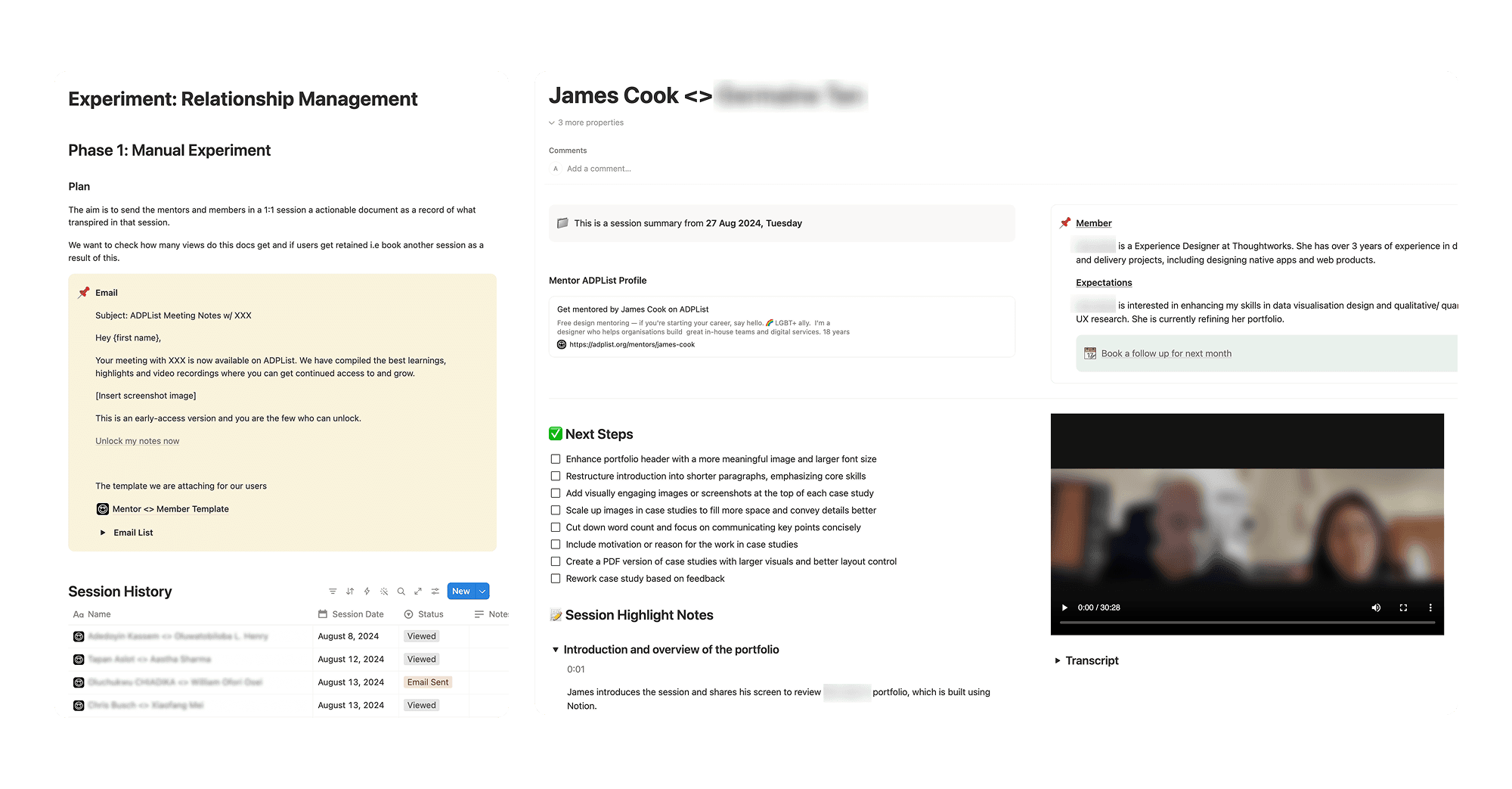
3 weeks. 200+ mentors and mentees. No code. Before asking for engineering time, I ran the whole thing by hand: session recordings summarised with ChatGPT, documented in Notion, emailed to both sides. Nobody was chosen for being likely to say yes.

89% said it was exactly what they needed. The stronger signal was behaviour i.e., people read their notes before the next session and turned up prepared.

The manual version: call recordings summarised with ChatGPT, tracked in Notion, emailed to both sides. Three weeks, no code.

Approach

Make Session Notes Unmissable

The experiment settled what to build. Where it showed up was the main problem, because nobody came back to the platform on their own.

― The notes appear as soon as the call ends

The end of a call was the only moment both people were still on the platform, so the journal generates right there. A useful ending changes how a session is remembered, and whether people book again.

Notes first took 2 to 3 minutes. We got it down to 20 seconds. On a 45-minute call, the first version was too slow for a page that only works if people stay on it. Two changes fixed it: transcribing during the call, and switching to a faster model.

Post-session page - Where notes generate here, immediately after the call ends.

― Past sessions live on the homepage

Recent journals sit on the homepage, where people land anyway, and a new menu item keeps every past journal one click away.

Recent notes can be found on the homepage, then live in the Journals tab.

― A preview email that pulls people back

Not everyone sees the post-session page. Plenty of people just close the tab when the call ends. The email sends them a preview, not the full notes, so reading the rest means coming back to the platform. The point was to make coming back a habit.

The email brings people back to the full journal.

― A summary card people could download and share

The idea was to give a session a life outside the platform: a card with the key insights that people could save or share. It underperformed against what we expected.

Designed to be shared outside ADPList. People shared less than we hoped.

Decisions

Three Disagreements that Shaped the Launch

― Leadership wanted adoption. I chose consent.

Leadership worried that asking to agree to recording would alarm them and slow adoption. I argued: a mentorship call is personal, and anyone who doesn't want to be recorded shouldn't be. We launched with individual opt-in. If only one side agreed, only their voice was transcribed. 98% said opted in.

Asked at the right moments, never pushed. 98% opted in.

― Engineering traded editing for the launch date.

Engineering said editing would delay the launch. I pushed back: an AI record people can't correct costs trust and adoption. The date won. Once live, people flagged notes that misread what was said in their calls, and they had no way to fix them. Editing shipped two weeks after launch.

Editing, shipped after launch: people could finally fix what the AI got wrong.

― AI Model couldn't follow group sessions (yet!)

With multiple speakers, the summaries came out hard to attribute. Group sessions also hadn't been a priority feature, so their data pipeline needed upgrades before notes could run on them. I scoped the launch to 1:1 and kept testing models on group recordings until the output held up. Group sessions shipped four weeks after launch.

Impact

Mentors stayed, and mentees came back to them

― For the users

Sessions became relationships. 63% of returning mentees rebooked the same mentor. That's the number that matters most. Also, 98% of users opted in to recording. People read their notes before the next session and turned up prepared.

― For the users

Sessions became relationships. 63% of returning mentees rebooked the same mentor. That's the number that matters most. Also, 98% of users opted in to recording. People read their notes before the next session and turned up prepared.

― For the business

Mentor supply had depended on constant acquisition. Mentor retention rose 34% and mentee retention 22% over 90 days. The brief was mentees, but the supply side moved furthest.

― For the business

Mentor supply had depended on constant acquisition. Mentor retention rose 34% and mentee retention 22% over 90 days. The brief was mentees, but the supply side moved furthest.

Reflections

What worked

  • Automate what your users already do. Mentors with lasting mentorships were already sending notes by hand. Journals took their habit and did it for them, instead of asking anyone to learn.

  • Design for the side the business depends on. The brief was mentee retention. Building around mentor behaviour moved mentor retention further.

  • In AI products, speed is part of the design. At 2 to 3 minutes, people would have left at the one moment the page depended on. Getting to 20 seconds mattered as much as the layout.

What I'd do differently

  • Ship correction in the first version. Cutting editing kept the scope tight, but an AI record nobody can fix loses trust fast, and people noticed straight away.

  • Test by hand sooner. Connections showed the signal back in 2021. Three weeks with no code settled what years of that feature hadn't.